
WhatsApp Marketing ROI: Calculate, Measure & Maximize Returns
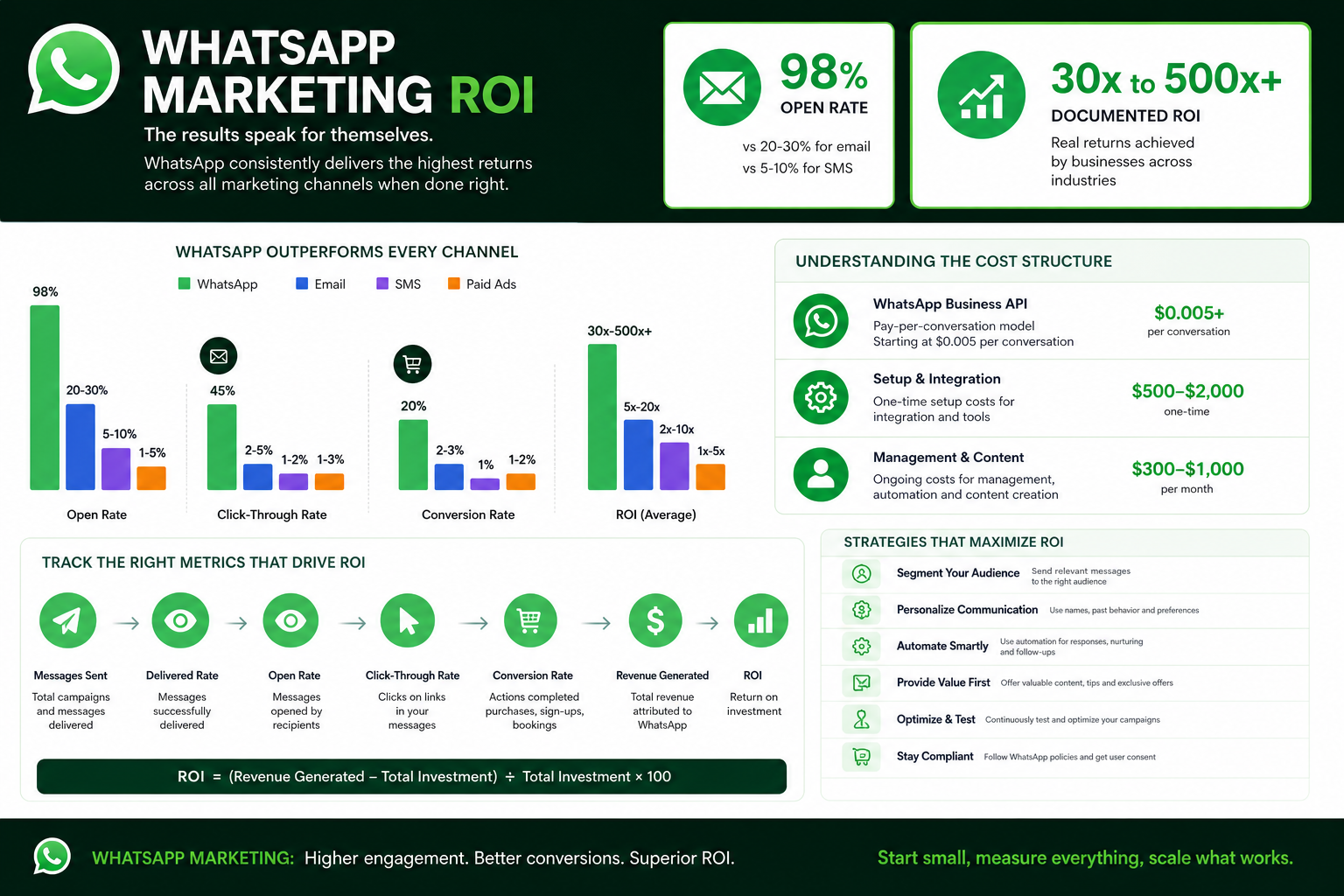
WhatsApp marketing ROI has become the deciding factor for businesses evaluating whether to invest in this channel. With 98% open rates and documented returns ranging from 30x to over 500x, WhatsApp consistently outperforms email, SMS, and paid advertising. But these impressive numbers only materialize when you understand the cost structure, track the right metrics, and implement strategies that leverage WhatsApp's unique engagement advantages.
This comprehensive guide reveals exactly how to calculate WhatsApp marketing ROI, what benchmarks to expect across different industries, and the proven tactics businesses use to maximize their returns. Whether you're considering WhatsApp for the first time or looking to optimize existing campaigns, you'll learn the frameworks and formulas that separate profitable WhatsApp marketing from wasted budget.
What Is WhatsApp Marketing ROI and Why It Matters
WhatsApp marketing ROI measures the revenue generated from WhatsApp campaigns relative to the total cost of running those campaigns. Unlike other channels where messages compete in crowded inboxes or get buried by algorithms, WhatsApp delivers directly into the personal communication space customers check constantly throughout the day.
This fundamental difference explains why businesses prioritize ROI measurement before scaling WhatsApp campaigns. The channel demands respect—customers grant access to their most personal communication tool, and misuse results in immediate blocks, opt-outs, and potential account restrictions. Understanding ROI helps businesses determine the right audience size, message frequency, and content strategy that balances revenue generation with customer experience.
Key factors influencing WhatsApp marketing returns include audience segmentation quality, message personalization depth, timing precision, cost structure selection, and compliance with platform policies. Businesses that treat WhatsApp like email—blasting generic messages to entire contact lists—consistently underperform those that segment audiences, personalize content, and reserve the channel for high-value moments.
WhatsApp Marketing ROI Benchmarks: What to Expect
Real-world WhatsApp campaign ROI varies significantly based on industry, audience quality, and execution. However, documented case studies reveal consistent patterns that help set realistic expectations.
Industry surveys show that 94% of businesses report positive WhatsApp marketing ROI within 12 months. Conservative campaigns typically achieve 30x-100x returns, while highly optimized campaigns targeting engaged audiences have documented returns exceeding 500x. These numbers dwarf traditional email marketing, which averages 36x ROI according to industry benchmarks.
| Metric | Advantage | ||
|---|---|---|---|
| Open Rate | 70-98% | 15-25% | 4-5x higher |
| Read Time | Within 5 minutes | Within 6 hours | 72x faster |
| Click-Through Rate | 45-60% | 2-5% | 10-15x higher |
| Revenue Per Message | $0.50-$2.00 | $0.08-$0.30 | 6-7x higher |
| Average ROI | 30-500x | 36x | Up to 14x higher |
Conversion rate benchmarks vary by campaign type. Flash sales and limited-time offers convert at 8-15%, product launches at 5-12%, abandoned cart recovery at 10-18%, and general promotional broadcasts at 3-8%. These conversion rates consistently exceed email benchmarks by 3-5x across all categories.
Timeline expectations matter for planning. Most businesses see measurable results from their first campaign, especially for time-sensitive promotions. However, building a high-performing WhatsApp marketing program typically requires 3-6 months to optimize audience segmentation, refine messaging, establish frequency cadence, and develop attribution systems that accurately track revenue.
How to Calculate WhatsApp Marketing ROI: The Complete Formula
Calculating accurate WhatsApp campaign ROI requires understanding both the formula and the specific cost and revenue components unique to this channel.
The Basic ROI Formula for WhatsApp
The fundamental calculation follows standard marketing ROI methodology:
ROI = [(Revenue - Cost) / Cost] × 100For example, if a campaign generates $15,000 in revenue and costs $500 to execute, the calculation would be: [($15,000 - $500) / $500] × 100 = 2,900% ROI, or a 29x return.
Identifying All Cost Components
Accurate ROI calculation requires tracking every cost element. For WhatsApp marketing, these include message delivery fees (if using WhatsApp Business API), platform subscription costs, setup and integration expenses, content creation and design fees, and time investment for campaign management.
Message costs vary dramatically based on approach. WhatsApp Business API charges per conversation, with marketing conversations costing $0.015-$0.14 per message depending on country. A 10,000-message campaign could cost $150-$1,400 in delivery fees alone. Alternative no-API solutions eliminate per-message costs entirely, charging only monthly platform fees.
Revenue Attribution Methods
Tracking revenue accurately determines whether your ROI calculations reflect reality. The most reliable attribution methods include unique promotional codes (exclusive to WhatsApp campaigns), UTM parameters in links (tracking clicks through to purchase), direct e-commerce integration (connecting WhatsApp sends to order data), and customer surveys (asking how they discovered the offer).
Step-by-Step Calculation Example
Consider an e-commerce business running a flash sale campaign. They send 5,000 personalized messages to previous customers. Costs include: $200 in message fees (API solution), $50 platform subscription, $100 for image design, totaling $350. The campaign generates 425 clicks (8.5% CTR) and 68 purchases (16% conversion rate) with an average order value of $85. Total revenue: $5,780. ROI calculation: [($5,780 - $350) / $350] × 100 = 1,551% ROI, or approximately 15.5x return.
WhatsApp Marketing Costs: API vs No-API Solutions
The single biggest factor affecting your WhatsApp marketing ROI is which platform approach you choose. The cost difference between WhatsApp Business API and no-API solutions can shift campaign economics from marginal to exceptional.
WhatsApp Business API Conversation-Based Pricing
The official WhatsApp Business API uses conversation-based pricing that charges per 24-hour messaging window. Marketing conversations (business-initiated messages) cost $0.015-$0.14 per conversation depending on the recipient's country. Service conversations (customer-initiated support interactions) cost $0.005-$0.08 per conversation.
The 24-hour service window rule significantly impacts costs. When a customer messages your business, a free 24-hour window opens during which you can send unlimited service messages at no additional charge. After hour 25, any new message starts a new billable conversation. This structure works well for businesses with high volumes of customer-initiated conversations but adds substantial costs for marketing broadcasts.
No-API Browser-Based Tools
No-API solutions work through WhatsApp Web, eliminating per-message fees entirely. These tools connect your spreadsheet data directly to WhatsApp Web, enabling personalized bulk messaging without API costs. You pay only a flat monthly subscription, typically $15-$50 depending on features and message volume.
| Cost Component | WhatsApp Business API | No-API Solution |
|---|---|---|
| Message Delivery Fees | $150-$1,400 | $0 |
| Platform Subscription | $50-$500/month | $15-$50/month |
| Setup & Integration | $500-$5,000 | $0-$50 |
| Technical Resources | Developer required | No technical skills needed |
| Total First Campaign | $700-$6,900 | $15-$100 |
The trade-off centers on capabilities versus cost. API solutions offer advanced automation, chatbot integration, CRM connectivity, and enterprise-grade features. No-API tools provide core broadcasting functionality—personalized messages with rich media—at a fraction of the cost. For most small and medium businesses testing or running straightforward campaigns, the cost savings dramatically improve ROI.
Essential Metrics to Track for WhatsApp Marketing ROI
Measuring WhatsApp marketing performance requires tracking specific metrics that reveal campaign effectiveness and identify optimization opportunities.
Delivery Rate: List Quality Indicator
Delivery rate measures the percentage of messages successfully delivered to recipient devices. Calculate it by dividing delivered messages by total send attempts. Healthy campaigns achieve 95-98% delivery rates. Lower rates indicate list quality issues—inactive numbers, incorrect formatting, or customers who've blocked your business number.
Click-Through Rate: Engagement Measurement
Click-through rate tracks how many recipients click links in your messages. WhatsApp doesn't provide native open tracking, making CTR your primary engagement metric. Strong campaigns achieve 45-60% click-through rates—dramatically higher than email's 2-5% average. Track clicks using shortened URLs with UTM parameters to measure both volume and attribution.
Conversion Rate: Revenue Driver
Conversion rate measures the percentage of recipients who complete your desired action—making a purchase, booking an appointment, or downloading content. Calculate by dividing conversions by messages delivered. Attribution challenges arise when customers interact with multiple touchpoints. Solve this using unique promo codes, dedicated landing pages, or first-touch attribution models.
Customer Lifetime Value Impact
WhatsApp's conversational nature builds stronger customer relationships that extend beyond single transactions. Track how WhatsApp engagement affects repeat purchase rates, average order value over time, and customer retention. Businesses often find that WhatsApp subscribers generate 30-50% higher lifetime value than email-only contacts, significantly improving long-term ROI even when individual campaign returns appear modest.
Setting Up Tracking Systems
Implement tracking by creating unique promotional codes for each campaign, using UTM parameters in all links (utm_source=whatsapp, utm_medium=broadcast, utm_campaign=campaign_name), integrating your WhatsApp platform with your e-commerce or CRM system, and establishing regular reporting cadences that compare WhatsApp performance against other channels.
7 Proven Strategies to Maximize WhatsApp Marketing ROI
Implementing these evidence-based strategies consistently separates high-ROI WhatsApp campaigns from underperforming broadcasts.
1. Audience Segmentation by Value and Behavior
Segment your audience based on purchase history (first-time buyers, repeat customers, VIPs), engagement level (active, dormant, at-risk), geographic location (for local events or region-specific offers), and product interests (category preferences, browsing behavior). Send targeted messages to segments rather than broadcasting to your entire list. A VIP customer segment receiving exclusive early access will outperform a generic broadcast by 5-10x.
2. Deep Personalization Using Customer Data
Generic messages destroy WhatsApp ROI. Personalize using customer names, purchase history references, product recommendations based on browsing, location-specific offers, and birthday or anniversary messaging. Tools that integrate spreadsheet data enable dynamic personalization at scale—each message feels individually crafted while you're actually sending thousands.
3. Optimal Messaging Frequency
The 1-4 messages per month sweet spot balances visibility with respect. More frequent messaging drives unsubscribe rates above 15% and risks account restrictions. Less frequent messaging leaves revenue on the table. Test frequency with your audience, but start conservative. One exceptional, well-timed message outperforms four mediocre broadcasts.
4. Strategic Timing for Maximum Impact
Reserve WhatsApp for moments when timing drives action: flash sales with 24-48 hour windows, product drops and new inventory announcements, back-in-stock alerts for high-demand items, Black Friday and holiday promotions, and appointment reminders to reduce no-shows. Send during optimal hours—early afternoon (1-3 PM) and early evening (6-8 PM) typically perform best. Avoid early mornings and late nights when messages feel intrusive.
5. Rich Media Integration
Text-only messages underperform. WhatsApp supports images (product photos, lifestyle shots, infographics), videos (product demonstrations, customer testimonials, unboxing content), documents (catalogs, price lists, menus, guides), and voice messages (personal touches for VIP customers). Messages with rich media see 40-60% higher engagement than text-only alternatives.
6. Compliance Practices to Maintain Deliverability
WhatsApp enforces strict policies. Violations result in number bans that destroy your marketing capability. Follow these rules: obtain explicit opt-in consent before messaging, provide easy opt-out mechanisms in every message, never cold message people who haven't opted in, implement rate limiting with random delays between messages, and use tools with anti-ban features like message preview and number verification.
7. Continuous A/B Testing
Systematic testing compounds ROI improvements over time. Test message copy (benefit-focused versus feature-focused), call-to-action phrasing ("Shop now" versus "View collection"), send timing (morning versus evening), personalization depth (name only versus name plus purchase history), and offer types (percentage discounts versus dollar amounts). Run tests on 10-20% of your audience before full deployment. Small optimization gains multiply across campaigns.
Real WhatsApp Marketing ROI Case Studies
Documented results from real businesses demonstrate what's achievable when strategy meets execution.
E-Commerce: 51% Increase in Repeat Orders
An online fashion retailer segmented customers by purchase frequency and sent personalized product recommendations via WhatsApp. They achieved 51% higher repeat purchase rates compared to email-only customers. The key success factors included tight segmentation (targeting customers who'd purchased within 90 days), deep personalization (recommendations based on previous purchases), and strategic timing (new collection launches and restocks).
Education: 71% Higher Student Engagement
An online education provider used WhatsApp to send course reminders, deadline alerts, and motivational messages to enrolled students. They documented 71% higher course completion rates and 3.2x better assignment submission rates compared to email-only communication. The conversational nature of WhatsApp created accountability and connection that email couldn't replicate.
Retail: 64% Pre-Listing Sales Conversion
A furniture retailer sent WhatsApp messages to previous customers when new inventory arrived. Before items were listed on their website, 64% of stock sold through WhatsApp conversations. This pre-listing strategy created urgency, rewarded loyal customers with early access, and reduced inventory holding costs while maximizing margins.
Services: 42% Order Rate from Broadcasts
A meal delivery service sent weekly menu updates via WhatsApp to opted-in customers. They achieved a 42% order rate—meaning 42% of message recipients placed orders that week. By comparison, their email campaigns generated 6% order rates. The difference came from WhatsApp's immediacy and the conversational ability to answer questions before purchase.
WhatsApp transformed our customer communication. We're seeing 8-10x better engagement than email, and our repeat purchase rate increased 47% after implementing WhatsApp campaigns. The ROI is unlike anything we've experienced with traditional marketing channels.
Marketing Director, E-Commerce Brand
Choosing the Right WhatsApp Marketing Approach for Your ROI Goals
Selecting between WhatsApp Business API and no-API solutions significantly impacts your ROI trajectory. The right choice depends on your business size, technical resources, budget, and growth stage.
When WhatsApp Business API Makes Sense
Choose the official API when you send 50,000+ messages monthly, need complex automation and chatbot capabilities, have dedicated technical resources for integration and maintenance, require native CRM or e-commerce platform integration, and have budget flexibility that prioritizes features over per-message costs.
When No-API Solutions Deliver Better ROI
Choose no-API tools when you're a small to medium business, want to test WhatsApp marketing without significant commitments, prefer working in familiar tools like spreadsheets, need to avoid per-message costs to improve margins, or want to get started quickly without technical setup. These solutions provide core functionality—personalized bulk messaging with rich media—at a fraction of API costs.
| Factor | WhatsApp Business API | No-API Solution |
|---|---|---|
| Best For | Enterprises, high volume | SMBs, testing, budget-conscious |
| Monthly Cost | $500-$5,000+ | $15-$50 |
| Per-Message Fee | $0.015-$0.14 | $0 |
| Setup Time | 2-8 weeks | Same day |
| Technical Skills | Developer required | Spreadsheet skills only |
| Best ROI Scenario | 50,000+ messages/month | Under 50,000 messages/month |
Migration Path: Testing to Scaling
Many successful businesses start with no-API solutions to validate WhatsApp marketing for their audience, then migrate to API platforms as volume scales. This approach minimizes upfront investment while proving ROI before committing to enterprise solutions. Start with a no-API tool, test campaigns on smaller segments, measure results rigorously, and scale to API solutions only when volume justifies the cost structure.
FAQ: WhatsApp Marketing ROI Questions Answered
What is a good ROI for WhatsApp marketing campaigns?
Based on documented case studies and industry surveys, a 30x-100x ROI is achievable with proper audience segmentation and targeting. Conservative campaigns targeting engaged customers typically achieve 30-50x returns, while highly optimized campaigns with VIP segments can exceed 500x. For planning purposes, aim for at least a 5:1 return (500% ROI) as your minimum threshold. Anything below suggests issues with audience quality, message relevance, or offer strength that require optimization.
How does WhatsApp marketing ROI compare to email marketing?
WhatsApp typically delivers 2-10x better performance than email depending on campaign type and execution. While email averages 36x ROI with 15-25% open rates, WhatsApp achieves 30-500x ROI with 70-98% open rates. Revenue per message is often 6-7x higher on WhatsApp ($0.50-$2.00 versus $0.08-$0.30 for email). However, WhatsApp requires more careful audience management and compliance, making it best suited for high-value moments rather than replacing all email communication.
What factors have the biggest impact on WhatsApp marketing ROI?
The five factors with the largest ROI impact are audience segmentation quality (targeted segments outperform broadcasts by 5-10x), message personalization depth (personalized messages convert at 6x higher rates), cost structure selection (API per-message fees versus no-API flat rates can swing profitability), timing and frequency (1-4 messages per month at optimal hours), and offer relevance (matching offers to customer interests and purchase history). Businesses that excel at all five factors consistently achieve the highest documented returns.
How long does it take to see positive ROI from WhatsApp marketing?
Most businesses see measurable results from their first campaign, especially for time-sensitive promotions like flash sales or product launches. Research indicates that 94% of businesses report positive WhatsApp marketing ROI within 12 months. However, building a high-performing program that consistently delivers strong returns typically requires 3-6 months to optimize audience segmentation, refine messaging approaches, establish the right frequency cadence, and develop attribution systems that accurately track revenue. Start with small tests, measure rigorously, and scale what works.
Can small businesses achieve strong WhatsApp marketing ROI?
Yes, small businesses often achieve exceptional WhatsApp marketing ROI, especially when using no-API solutions that eliminate per-message costs. The combination of low platform fees ($15-$50 monthly), zero message delivery costs, and high engagement rates creates ideal economics for smaller campaigns. Small businesses can start with free or low-cost tools, test campaigns on small customer segments, measure results carefully, and scale successful strategies without requiring large upfront investments. The key is starting with clear goals and proper measurement rather than blasting entire contact lists.